
Why Does Paint Fade and Peel So Fast in Las Vegas?
The sun here is the harshest thing your house deals with. Paint choices that work elsewhere do not.
Paint that would give you ten years in a temperate climate can look tired here in four, and homeowners reasonably conclude they were sold cheap material. Sometimes they were. More often the paint was ordinary and the conditions were not.
Three things drive it, and only one of them is the product in the can.
Why the same paint behaves differently here
UV load
Southern Nevada gets among the highest solar radiation in the country. Ultraviolet light breaks down the binders and pigments in paint, and it does it continuously, all year, with very little cloud cover to interrupt it.
Surface temperature
Air temperature is not the number that matters. A dark wall in direct afternoon sun can reach far higher than the ambient reading, and coatings expand, contract and embrittle through that cycle every single day.
Pigment survival
Reds, deep blues and bright yellows fade first because those pigments are the least UV stable. Earth tones, greys and off-whites hold their color for years longer, which is a large part of why the valley looks the way it does.
Chalking
As binder breaks down, pigment is left loose on the surface. Rub a faded wall and grey powder comes off on your hand. Painting over chalk without washing it first guarantees the new coat peels, because it is bonded to dust.
Irrigation and splashback
Sprinklers hitting a wall, and hard water in particular, will lift paint at the bottom of a wall long before the sun gets to the top of it. Mineral deposits also leave a white bloom that no amount of paint will hide.
Painting in the wrong conditions
Applying paint to a hot surface makes it flash off before it can level or bond. In July an afternoon west-facing wall is genuinely too hot to paint, and doing it anyway is a common cause of a coat failing within two years.
Inside the house, the sun is still the problem
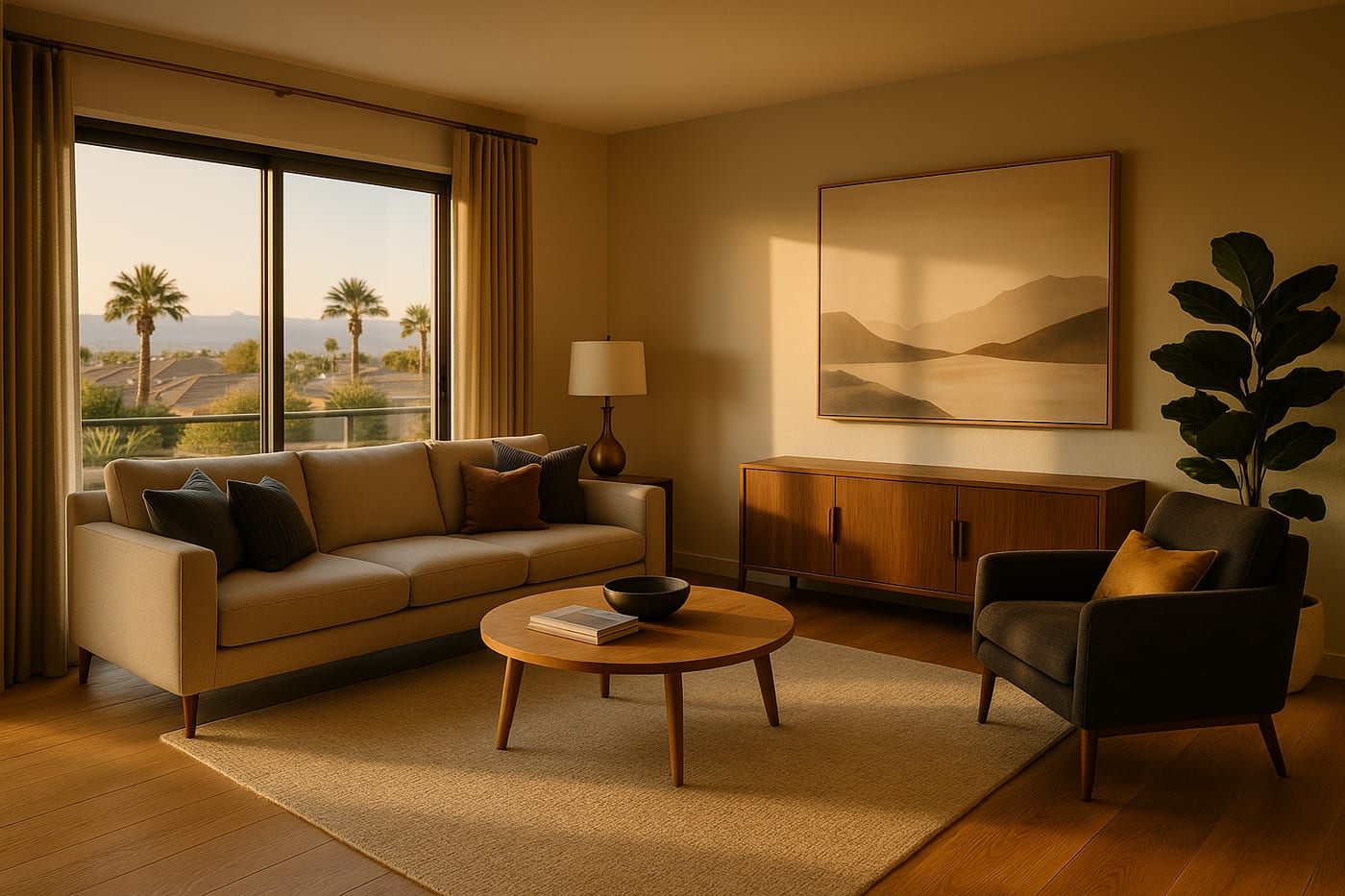
Interior paint does not peel from UV, but it does fade, and Las Vegas homes tend to have large windows and a great deal of direct light. A south or west-facing room will visibly shift over a few years, which becomes obvious the moment you move a picture or a bookcase.
It also drives sheen choice. Higher sheens reflect light and show every imperfection in a wall, and in strong raking light through a big window that is unforgiving. On a knockdown-textured wall, which is most of this valley, matte and eggshell finishes hide far more than satin does. Our post on why every Las Vegas house has knockdown texture covers why that surface behaves the way it does.
The same light fades flooring, furniture and artwork on the same wall, which is worth planning around rather than discovering. It is the reason species and finish choice matter so much on a hardwood floor here, where a rug left in one place for two years leaves a visible outline once you move it.
Choosing sheen, color and the order rooms get painted is part of what we work through on an interior painting project rather than something you should have to specify yourself.
Five things, in order of how much difference they make
Wash and de-chalk first
Nothing else on this list matters if the new coat is bonded to loose pigment. Exterior walls get washed and, where chalking is heavy, a bonding primer.
Prime the problems
Bare stucco, repairs, stains and any significant color change get primer. Skipping it is why a deep color needs four coats and still looks uneven.
Choose the right product tier
This is the one place where paying more genuinely returns it. Higher grade exterior coatings carry more and better UV-stable binder, and in this climate that is the difference between six years and twelve.
Think about color and sheen deliberately
A dark saturated exterior color in full sun is a choice with a maintenance cost attached. It is a legitimate choice, and you should make it knowing that.
Work the right side at the right time
We follow the shade around a house rather than working straight through the day, and we do not put coating on a wall that is too hot to keep a hand on.
Paint in the Las Vegas climate
How often does a Las Vegas house need repainting outside?
With good preparation and a quality coating, roughly seven to twelve years. With poor prep or a budget product, as little as four. South and west elevations always go first, and repainting only those is a legitimate way to spread the cost.
Why is my paint peeling in sheets rather than flaking?
Sheet peeling almost always means an adhesion failure rather than weathering, and the usual cause is painting over chalk, dirt or a glossy surface without prep. It can also mean moisture pushing from behind, which is worth ruling out.
Is elastomeric coating better here?
For stucco with fine cracking, often yes, because it bridges hairlines and moves with the wall. It is thicker and more expensive, and it is not the right answer over a surface that is debonding.
What is the best time of year to paint outside in Las Vegas?
Spring and autumn, comfortably. Summer exterior work is possible if the crew chases shade and starts early, but a wall in direct July sun is a poor surface to be coating.
Will dark colors really fade that much faster?
Yes, noticeably. Deep reds and saturated blues are the least UV stable and will shift within a few years in full sun. If you want a dark exterior, budget for repainting sooner.
Do interior walls need repainting as often?
No, and most interiors go a decade or more. The exceptions are rooms with heavy direct sun, where fading rather than failure is what eventually prompts it.
Want someone to look at it?
Describe what you are seeing, or send a photograph. We will tell you whether it is cosmetic or structural, and we will say so plainly when the answer is that you need a different trade.
Get My Free Written Estimate